All Grass Types Are Divided
Into Two Categories
While there are only grass types, cool season and warm season grasses, there are thousand of grass species throughout the wold.
Except for a few species, most grasses will come in only two colors: green and tan. Green when growing and tan when dormant.
An Answer to a Commonly Asked Question
In early spring, especially in lawns that are not well maintained, it is common to see a mixture of green cool season grass mixed in with still dormant warm season grass. The photo below is a good example.
In case you are curious, here is why you see grasses greening up at different times:
Cool season grass remain a light shade of green through winter and will start greening up and growing in early spring. These grasses will thrive in temperatures from 65 to 75 degrees.
However, warm season grass types emerge from
dormancy in late spring and thrive in temperatures from 80 to 95
degrees. It is built into the plant's genetic structure to begin growth
at specific soil temperatures.
A well-planned and maintained lawn will often have a single type of grass. Whether it is a warm or cool season grass depends on the geographical location, climate zone adaptation of a specific grass variety and the personal choice of the owner. In certain situations, for example with southern bermudagrass lawns, a lawn may purposely have both types to maintain color year around. However, in most cases where both types exist, it is a sign of a lawn that was let go for many years or due to encroachment from neighboring lawns.
Therefore, where the two different grass types exist, you will see the green and tan mixture from fall until early spring.
All warm season grasses lose chlorophyll in the fall and turn from green to tan. Cool season grass types, however, will often remain a shade of green through the winter.
A View of Two Grass Types
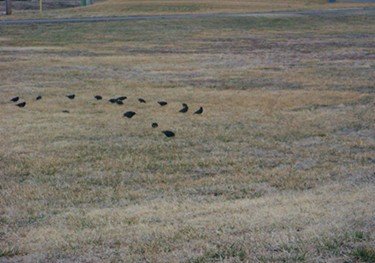
This photo was taken in mid-winter. It is a field that receives no care during the year except for mowing. As mention earlier, the photo shows a mixture of straw colored, warm season grass as well as green, cool season grass scattered throughout. The birds, like those shown, are largely responsible for depositing seeds of many different grass types and weeds. (Photo taken by Russ James)
List of Common Cool Season Grasses
The following is not an exhaustive list, but contains some commonly used cool season lawn grasses. More detailed descriptions and uses of these grasses can be found in the Cool Season Grass section of this site.
- The fescues- There are two major groups of fescue grass: Fine fescues and coarse fescues. Fine fescue originated in Europe and in the U.S. is primarily marketed as a shade gras only.Originally, tall fescue (coarse fescue) was developed for field use as a forage crop, but many excellent turf-type varieties have been developed. Be sure to look for bags with "Turf Type" fescue printed on it.
- Bluegrass- The two basic types are common bluegrass and improved bluegrass varieties. The common or "public" variety is best used on sites that receive only occasional fertilization because of disease problems. Improved varieties of bluegrass are the better choice if the site is receiving regular fertilizer treatments.
- Ryegrass- Perennial and annual types. Annual ryegrass has a one year life cycle and will need to be reseeded each year. Both types are often used for overseeding dormant warm season grasses in fall. It is also used in seed mixtures because of fast germination and quick establishment. Some varieties of perennial ryegrass form quality turf.
- Bentgrass- Creeping bentgrass is most often used on putting greens because it tolerates low mowing necessary for a putting surface. It is considered a high maintenance turfgrass and rarely used by homeowners.
- Brome, Timothy, and Orchard Grass are field grasses that are sometimes found in home lawns, but generally will not produce a quality turf. They are often used in roadside seed mixtures.
Common Warm Season Grasses
Warm season grasses are the choice of many in warmer climates. Many grasses within this group spread by "runners" and can easily fill in injured areas. For detailed information about each of these grasses, look in the Warm Season Grass section. Examples of common warm season grasses include:
- Bermudagrass- It has common and improved varieties and is the most commonly used warm season grass. It grows wild in many lawns and can be invasive if it is not wanted. It can also become a thick, quality turf when properly maintained. The uses of the improved varieties range from golf greens and fairways, to home lawns. One of the disavantages to bermudagrass is that it has very poor shade tolerance.
- Zoysiagrass- This grass has its origins in the Japan. It makes a thick turf and can be started from plugs, seed or sod. Seed is expensive and slow to establish. It has become a popular grass in the transitions zone.
- St. Augustinegrass- Commonly used in the south from Florida and all along the Gulf Coast states as far as Texas. It doesn't have the cold tolerance so it is restricted to the south. Dallas Texas is approaching its most northern range. Currently, there is no seeded varieties. It must be started by plugs or sod.
- Centipedegrass- It is not as widely used as the other warm season grasses, but is on the increase. Range is from Florida along the Gulf coastal regions as far as Texas.
- Kikuyugrass-It is used as turfgrass, but only in the tropics and is considered a noxious weed in most of the U.S. Only a few counties in a few states allow it. It is one of the fastest spreading grasses and can be extremely invasive. It will cover over shrubs, fences, light poles and will displace other grasses. It is not recommend.
- Buffalograss- Blue-green in appearance. It is native to the arid prairie regions of the U.S. For that reason, it is often used in arid areas because of its lower water requirements. It has one of the widest north to south ranges of a warm season grass from Mexico to Canada. However, it can only grow west of the Mississippi River where there is less rainfall each year. It can't survive in wet states. Improved varieties can make excellent turf grass.
Climate Zones of the U.S.
Unlike some plants, you can't bring your grass indoors when
conditions don't favor it. Choosing the right grass for your climate
zone is important.
Watering a New Lawn
Watering a new lawn is very different from watering a mature lawn.
When planting a new lawn, success will be greatly increased by learning
proper watering techniques.
Cool Season Grass Cultivars
Many grass types have numerous varieties to choose from. Click here to see the "cool season grass cultivars" that are available.
Warm Season Grass Cultivars
Many improvements have been made with warm season grasses in the last few years. Click here for a list of popular "warm season grass cultivars".
Cool Season Grasses
Detailed information of popular cool season grasses in the U.S.
Everything you need to know including the pros and cons, maintenance
tips, and insect and disease problems.
Warm Season Grasses
Detailed information on popular warm season grasses. Which one is
right for you, pros and cons, and tips on how to care for each one.
Plant Growth Regulators
Plant Growth Regulators are just beginning to be discovered by
homeowners. They are fantastic products with dozens of uses for
everything from slowing grass growth to eliminating unwanted tree fruit.
Click here to discover what you have been missing.
Grass Types to Lawn Care Academy Home.
Share This page: