Kentucky Bluegrass - America's Favorite Cool Season Grass
Kentucky bluegrass is by far the favorite and most widely used of all the bluegrass species.
It is one of the more beautiful cool season lawn grasses. It is known for its excellent color, density and texture. It can be purchased in both seed or sod. Kentucky bluegrass seed is commonly included in seed mixtures with cool season turf grasses.
How to Identify K. Bluegrass
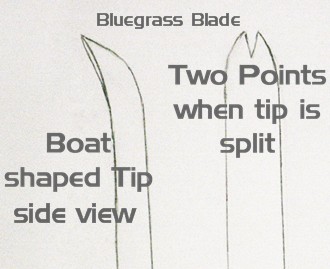
The easiest method of identifying K. bluegrass is to look for the boat shaped tip. If you look carefully, the tip of the blade folds together to resemble the bow of a boat. If you pull the length of the grass through your fingers, the tip will split, leaving two small points. Only orchardgrass has a similar shaped tip.
You can also look for very narrow, upright standing grass blades that come to a point. Other grass types, such as fescue will have much wideer blades in comparison.
Bluegrass’ advantages
Bluegrass forms a dense and attractive turf. For some people, the thin blades are more appealing than wider bladed grasses.
Kentucky Bluegrass has a solid advantage over other cool season grasses by its ability to spread. The fact that it can spread and heal itself when damaged is probably the greatest reason for its popularity. It spreads through the production of rhizomes. See Plant Structure for a complete explanation of rhizomes. Rhizomes are stems that grow horizontally just below the surface of the ground. Each rhizome produces a "node" every few inches along its length from which a new bluegrass plant will sprout. Bluegrass is an excellent choice for busy lawns where backyard activities tend to wear down the turf. Athletic fields will often use a combination of bluegrass and perennial ryegrass. The bluegrass will heal damages and perennial ryegrass is used for its high wear resistance.
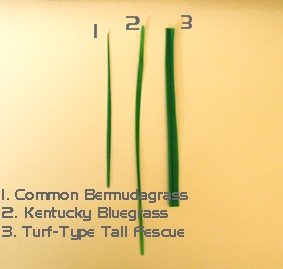
Kentucky bluegrass seed is often blended with turf-type tall fescue seed when grown for sod production. Most tall fescue varities don't have the structure to hold sod together very well, but bluegrass does. When sod is harvested, the roots are cut, but the rhizomes from the bluegrass keep the sod from falling apart.
Sports fields planted with fescue will usually add K. Bluegrass. This is because the grass will spread and heal any damaged spots. Fescue doesn't produce runners so bluegrass has this as an advantage and is almost always included in the mix.
Since the rhizomes grow underground, they help ensure the survival of the plant. It can survive damage that would kill other grasses. Even if the grass is removed at ground level, bluegrass could still grow back because of the underground growing points on the rhizomes.
Kentucky bluegrass has better cold tolerance than other cool season grasses. It can withstand periods of very cold weather that would normally damage fescue or ryegrass. The adaptation zone for bluegrass extends through the cool/humid and cool/arid regions.
However, bluegrass doesn't do well in the south. It is too hot. I have heard from people as far south as Dallas, TX asking how to keep their bluegrass alive. It is always best to choose a grass that does well where you live.
Bluegrass Disadvantages
Kentucky Bluegrass is considered a high water user in summer, partly due to a shallower root system than other grasses. Without proper irrigation or sufficient rainfall in summer, bluegrass is one of the first grasses to go dormant.
On the up side, however, even after extended drought, bluegrass has the remarkable ability to recover from dormancy without damage.
Another disadvantage is that Kentucky Bluegrass is not very shade tolerant and will thin or die if planted in heavy shade. Rough bluegrass, on the other hand, is a variety of bluegrass that has much better shade tolerance. Shade grasses, such as fine fescues, are also compatible with Kentucky bluegrass.
Common and Improved Bluegrass Varieties
There are two basic categories of Kentucky bluegrass: Common bluegrass varieties and improved bluegrass varieties. To see the specific varieties, click on the Cultivars page.
Common bluegrass varieties are the oldest cultivars of Kentucky bluegrass. The older varieties are used in many seed mixtures and is the type usually seen growing in home lawns. The term used for these older varieties have become known as the "public varieties". It is a very attractive lawn grass with all the attributes listed above. However, the major drawback is that the older cultivars are highly susceptibility to the fungal grass disease called "leaf spot".
Common bluegrass varieties are best used on sites that will not be receiving regular fertilization and irrigation. This is because common bluegrass will become too disease prone when placed on a fertility program.
This presents a problem with seed mixtures sold in lawn and garden stores. Many of these stores that offer bluegrass, sell the older "public variety". Again, it is not a problem unless you intend to fertilize regularly throughout the season. It is better, if possible, to purchase your seed through a store or warehouse that supplies the landscape and turf industry. Many of these warehouses sell to the public and their employees have a better product knowledge. You can usually get improved Kentucky bluegrass blends that are resistant to leaf spot.
Improved varieties
Improved varieties were released many years after common bluegrass varieties hit the market. These cultivars have been developed for athletic and sports fields where there is more intense maintenance. Improved bluegrass was designed to be much more resistant to various grass diseases and also have a slower growth rate. Some varieties make a great lawn grass.
Bluegrass Maintenance
Irrigation and Drought Tolerance
Bluegrass has the natural ability to survive several weeks or even months of drought. Following a drought, new growth will spring up from the rhizomes. Bluegrass has a shallow root system, so if it doesn’t rain, it will need to be watered a couple times a week during the summer to keep it green. Kentucky bluegrass should receive at least 1/2 inch with each watering.
Mowing Requirement
Kentucky bluegrass can be mowed as low as 1.5 inches in the cooler times of the year. This height increases to 3 to 4 inches in summer to help it survive the summer heat. Personally, I rarely adjust my mower below 4 inches all year. That may seem high if you are not used to it, but the grass quickly adjusts. The additional blade length enables the grass to endure drought and heavy traffic.
Fertilization
In the industry, the amount of fertilizer is stated in pounds of Nitrogen per 1000 sq. ft. per year. Kentucky bluegrass requires 4-5 lbs of nitrogen per 1000 sq. ft. per year. There is an easy formula for determining how much fertilizer to apply regardless of the percent of nitrogen in the bag. Click on getting the correct fertilizer rate.
Insect Problems
Bluegrass can suffer damage from white grubs, billbugs, sod webworms, and leafhoppers. White grub controls can be applied as a preventative. You can use products like Merit by Bayer, Grub-Ex by Scotts, or similar products. With these products, they only kill the insects that feed on the grass and not beneficial insects. Insecticides can also be applied as soon as damage is seen. Damage can occur quickly, so it is important to monitor for insects or be aware of the time when they are active.
Disease Problems
"Leaf Spot", "Melting Out Disease", and "Rust" are three of the more common diseases that affect the common bluegrass varieties. They can best be controlled by proper watering techniques and infrequent use of high nitrogen fertilizers. However, rust problems are usually indicative of low nitrogen soils. A little nitrogen fertilizer will help with rust.
Very often when I see rust on grass, I will check to see if it is on the bluegrass. From my experience it will often begin there and spread to other grass or remain only on the bluegrass.
Necrotic Ring Spot is another serious disease of heavily fertilized bluegrass. Once established, it is difficult to control. Fungicide treatments are necessary.
Preventative maintenance includes core aeration to relieve soil compaction and to help control thatch. As with all grasses, knowledge on the use of organics to build up beneficial micro-organisms is extremely helpful. Beneficial micro-organisms are the natural enemies of disease pathogens.
Consider our product, AgriGro Turf Formula or Bountiful Harvest Biostimulant. Research has shown it increases beneficial microorganisms 3400% in the first 24 hours after application. This explosion of microorganisms breaks down soil elements fast and delivers nutrients to the roots. This feeds the turf with less applied fertilizer. It is shown to suppress many diseases.
Click here to see what AgriGro can do for your lawn.
Other Bluegrass Varieties
Rough Bluegrass
Rough bluegrass is used in shaded and damp areas. It does not perform well in full sun or in arid locations. The exception is when is it used in winter to overseed dormant burmudagrass. This is about the only time when rough bluegrass can make a beautiful, full sun lawn.
Annual Bluegrass
Annual bluegrass is grassy weed with a one year life cycle. It is a "winter annual", meaning it germinates and matures in the fall, lives through the winter, and then produces seed in the spring before it dies. It is one of the first grasses to green up in the spring. It is most noticeable when other grasses haven’t yet come out of dormancy.
It presents the biggest problem in closely mowed turf where more sunlight reaches the blades. It can even survive on golf green that are mowed at 1/4 inch. Lawns that are mowed at 3 or 4 inches have less problems with annual bluegrass. It can easily thrive in a variety of soil conditions including heavily compacted soil. By the time warm season grasses green up, annual bluegrass has started dying back.
In areas like gravel driveways, Round-Up can be sprayed to control it and other weeds. In lawns, try to manage your grass is such a way that encourages the lawn grass and not the annual bluegrass. The easiest way is to raise the mower blade to mow at higher levels. It doesn't prefer sites where there is too much competition, so maintaining a thick turf is helpful. To control annual bluegrass in warm season grasses, you can try overseeding in the fall with ryegrass. A pre-emergent applied in the fall before annual bluegrass germinates will help. However, only use a pre-emergent if you don’t intend to overseed.
Coarse and Turf-Type Tall Fescue Grass
Tall fescue is one of the best cool season grasses. It is preferred by many because of its dark green color, wear resistance and heat tolerance. Click here to find out everything you need to know about tall fescue.
Fine Fescue Grass
The fine fescue grasses are known for their exceptional shade and cold tolerance. They also have some of the narrowest blades of any grass type. Click here for detailed information about its climate range, uses and management.
Annual and Perennial Ryegrass
Ryegrass has come a long way with the introduction of new turf species. See all the pros and cons about using the perennial and annual varieties.
Overseeding Lawns - Detailed Tips and Techniques for a Beautiful Lawn
Lawn overseeding is one of the most overlooked practices by homeowners. However, it is one of the most important steps you can take to maintain a consistently thick and beautiful lawn. Find complete information on why and how to overseed correctly.
Watering a New Lawn
Watering a new lawn is very different from watering a mature lawn. When planting a new lawn, success will be greatly increased by learning proper watering techniques.
Understanding Organics and Organic Lawn Fertilization
An unbiased look at organic fertilizers, how they work and how to best use them to your advantage. Includes detailed information on natural organic fertilizers and organic/synthetic fertilizer blends.
All About Lawn Fertilization
Fertilizing a lawn can be tricky if you are not sure how to do it correctly. Find everything from understanding fertilizer ingredients to calculating fertilizer rates to planning your fertilizing schedule for the entire year and more.
Lawn Winterization Tips and Techniques
Fall winterization is the most important time for fertilizing cool season grasses. Warm season grasses do not receive the same treatment. Find everything you need to know to winterize both cool and warm season grasses.
Lawn Care Academy Products for Lawn and Garden
Lawn Care Academy's list of quality products that will help you develop and maintain your lawn and garden.
Kentucky Bluegrass to Lawn Care Academy Home