Straight From the Orient
The Amazing Zoysia Grass
Zoysiagrass, often spelled zoysia grass, originated in Japan and was brought to the U.S. in the late 1800’s. Commonly called zoysia for short, it is popular throughout the transition zone and is often viewed as a status symbol for home lawns. There are three major species: Z. japonica, Z. matrella and Z. tenuifolia.
Between the adaptation ranges of the three major species, zoysia has one of the broadest growth ranges of any warm season grass. Some varieties can survive the hot, humid climates of the deep south, while others can be found up to the Canadian border.
The Z. japonica variety can survive the severe winters of the northern states without injury. However, in the northern ranges, the growing season is so short that it may be dormant for half the year. Click here to see a Map of the Turfgrass Adaptation Aones.
In the transition zone, Zoysia is a favorite on fairways, sports fields, and other high traffic areas. This is because zoysia is one of the toughest grasses out there and can withstand a lot of punishment. It spreads by the production of rhizomes and stolons which allows it to fill in damaged areas. For more helpful information on how grass grows, see the page on
Plant Structure.
Low Nitrogen Requirement
of Zoysia Grass
of Zoysia Grass
Another advantage is that Zoysia grass also has one of the lowest nitrogen requirements of any turf species. Zoysia only requires about 2 lbs of nitrogen per 1000 sq. ft. per year. Bermudagrass can require 4 times as much.
Golf Courses spend thousands of dollars each year on high quality fertilizer. When you consider the high cost of fertilization, this makes zoysia very appealing to large sports organizations. It is also much better for the environment since it requires less nutrients and less weed control in summer.
For homeowners, it means less maintenance to produce a beautiful lawn.
Other major benefits of this grass is its excellent drought and salt tolerance.
The Three Primary Species of Zoysia Grass
Z. japonica is still one of the most common varieties of zoysia. This is the variety that was originally introduced to the U.S. It has exceptional cold tolerance and can be started from seed. Z. japonica doesn’t do well in the southern U.S., so its southern range stops somewhere in the middle of the transition zone.
Z. matrella came to the U.S. from Manila in the Philippines. Obviously, this grass can tolerate year long, hot, humid weather. In the U.S., it is primarily a southern grass. It forms a solidly thick turf and has finer blades than japonica. It cannot be started from seed, so it must be started vegetatively from sod or plugs.
Z. tenuifolia is a beautiful grass with the finest blades of all zoysia varieties. The downside is that is also has the lowest cold tolerance of all zoysia grass varieties. Researches have tried to boost the cold rating by crossing tenuifolia with japonica. The result is a fine textured grass with decent cold tolerance. The name given to this variety is Z. emerald and is a favorite among homeowners.
Some notes about planting zoysia
The popular varieties will usually be a cross of one or more the the three main grasses. Starting a zoysia grass lawn from seed is a slow process, much slower than starting other grasses from seed. Even if you are using zoysia grass plugs, the rate of establishment can be quite slow.
There are a number of cultivars that have been released in recent years. One of the most popular cultivars is meyer Zoysia, also called Z-52. The meyer variety is an improved variety of Z. japonica. Meyer does well in colder climates north of the transition zone. It has a medium green color with leaf texture about in the middle of the three main varieties. It can also handle partial shade. It must be started vegetatively.
A Special Note About Z. Meyer
In the past years, and maybe still today, you may have seen in newspapers and magazines an advertisement for a "SUPER" lawn grass. Many claims were made about it, such as, being almost fool proof, easy to care for and able to grow anywhere. "Just plant the grass plugs, and soon, you will have a beautiful, indestructible lawn".
What they were selling was Meyer Zoysia grass plugs. Although Meyer is a good variety, it's not the magical super grass the ads promised and had no mention of its preferred adaptation range or any negative characteristics. Some company made millions off that ad. I don't know if the homeowners were satisfied or not.
Advantages and Disadvantages
of Zoysia Grass
Advantages of Zoysia grass
All the zoysia grass varieties will either be a primary species or a hybrid of one or more of the three primary species. Since they all have different cold tolerances, textures, and speed of establishment, it is best to check with your local extension office to see which ones have the greatest success in your specific area.
Zoysia is a beautiful turfgrass that grows well in a variety of climates. It forms an extremely dense turf and is considered to be one of the most wear resistant of all grass species.
However, if the site is to have consistently high traffic that will wear down the grass, zoysia may not be the best choice. This is only because the slow growth means it tends to recover slowly. Bermudagrass or another grass may be a better choice in those situations.
Zoysia grass has exceptional drought and heat tolerance. The grass curls under in drought conditions to conserve water and prevent water loss through transpiration.
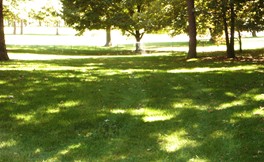
Most zoysia grass species have fairly good shade tolerance. In the south, the shade tolerance is greater than in the cooler regions of the north.
The photo in the left was taken in the evening and shows zoysia growing in a partially shaded location. This site does receive more light in late morning and mid-day. Zoysia grass does well as long as there is several hours of direct sunlight that reaches the grass. It thins in the deeper shaded areas.
Where cost is not a factor (zoysia is expensive), parks, sports stadiums, golf courses have all benefited greatly from this hardy grass. It can even be mowed to ½ inch in height without harming the grass. It has a low nitrogen requirement, only a quarter of what bermudagrass requires. As mentioned earlier, it does well at 2 lbs of nitrogen per 1000/sq.ft. per year.
Its high salt tolerance makes it an excellent grass for coastal regions.
Disadvantages
Zoysiagrass, like bermudagrass, will turn a golden tan when it goes dormant. Northern states will have a much shorter growing season than in the south. In far northern states, the growing season may be just a few months.
A common complaint is that zoysia is how slow it is to establish and spread. If you are planting a lawn by seed it can take a long time. Some seeds will not even germinate the first year.
If started by plugs or sprigs planted 6 inches apart, it will take up to two years to fill in. If not cared for properly, it could take longer. Weed control in thin areas will be a problem until it thickens up. Therefore, sod is the fastest means of establishment.
Different zoysia grass varieties will all have different rates of establishment. Northern states or countries with similar climates can expect even longer establishment rates due to the shorter growing season.
The cultivars, Blair Z. and El Toro Z., have a faster establishment rate than meyer Z. However, keep in mind, that even the faster spreading varieties can still be slow. Don't let that discourage you if you want a zoysia lawn. The grass is really beautiful.
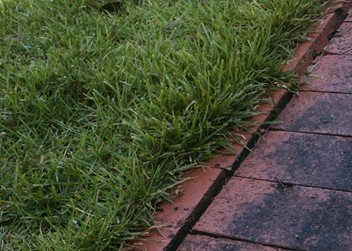
Zoysia grass can spread into a neighbor’s lawn, causing problems and can even break-up a good friendship. It’s aggressive nature can displace cool season grasses. It may be necessary to put a barrier in the soil that reaches below the rhizome level to help stop the grass from spreading where it is not wanted.
In the zoysia photo above, the brick sidewalk has been in place for several years and the grass has never crossed to the garden on the other side.
Zoysia Becomes Extremely Thick
Zoysia grass, when it reaches maturity and be extremely thick. Then it is considered to be a medium to high maintenance turfgrass. It can get so thick that it is hard to cut.
If you use a non-motorized, walk-behind reel mower you may be in for a shock. The thick grass has the tendency to build thatch and I have had trouble getting a heavy core aerator to penetrate the grass. It can also become quite weedy during dormancy until it greens up in spring.
Finally, zoysia grass seed is expensive. I paid about $120.00 around the spring of 2010 for a six pound bag. It was purchased at a landscape supply company that serves the industry, so I am not sure what the retail price is. Update: In 2021 I checked the seed prices again and currently they are running about $50.00 a lb.
Maintenance Requirements and Lawn Care Tips
Irrigation
Zoysia grass is a drought resistant grass. However, during drought conditions it will need to be well-watered each week during the summer. If the soil is sandy, it may require water more often.
Even in winter, while zoysia grass is dormant, in the absence of rain, it will still need to be watered occasionally to keep the grass from thinning in the spring.
Mowing
Many Zoysia grass varieties can be mowed as low as ½ inch. At this height, a very level soil surface is required so there is no scalping. It takes special equipment and knowledge to get the soil perfectly level, so this technique is generally reserved for sports organizations. Homeowners should not try to maintain their lawns at that level.
Many homeowners will mow the grass about once a week or whenever they feel it is in need of it. Regardless of how high you set the blade, mowing twice a week or every 5 days will keep your zoysia grass looking its best.
Keep The Mower Blades Sharp
Using a motorized reel mower will give the best results, but a rotary mower with sharp blades will provide a nice look. Zoysia can become very thick, so sharp blades are essential. The thicker the grass, the more strain on the mower. Sharp blades are essential for a clean cut.
Thatch
Zoysia grass has the tendency to produce heavy thatch. Thatch is not soil, but an organic layer that develops between the soil and grass vegetation, consisting primarily of shed roots and other grass debris. Over fertilization only contributes to the growth of thatch. Grass will shed its root system twice a year. It does this a root at a time, growing new roots to replace the old ones.
Thatch can be harmful in many ways. The grass roots can’t tell the difference between thatch and soil, so new roots will often grow in the thatch.
Thatch is a spongy material that absorbs large quantities of water and dries out must faster than soil. This robs the roots of needed water. If it completely dries out, it can become hydrophobic.
Hydrophobic means water will not penetrate, but instead, will pool on the surface of the thatch. IN addition, fertilizers, pesticides, and herbicides often become trapped in the thatch, never reaching the soil. Tests have shown that almost 100% of insecticides become trapped in heavy thatch. This can also prevent the insecticides from controlling the target insects.
Therefore, it is important to control the development of thatch. Annual core aeration opens up the soil allowing water and air to reach the root zone. Rent the heaviest core aerator you can find.
The very thick grass, including the thatch and root system can be hard to penetrate and will need a heavy machine to do the job effectively. Leave the cores on the soil to break down naturally.
As the cores break down, they feed the soil micro-organisms. Top dressing is the process of scattering organic matter over the surface of the soil. A thin layer of quality organic matter will also help feed the beneficial micro-organisms that feed on the thatch. If needed, vertical mowing or dethatching machines can be rented to tear out the thatch.
Burning
In rural areas, it is common to see homeowners set the grass on fire in the spring, a few weeks before the grass comes out of dormancy. This is done when the grass becomes too thick and thatchy.
There is no permanent injury to the turf and grass growth begins on schedule as weather warms up. This is partially due to the rhizomes. Rhizomes are underground stems. Being underground they are protected from the fire.
If you decide to burn, make sure it is okay to do this where you live and make sure you have a hose ready just in case. Be sure to tell your neighbors what you are doing. If you don't, believe me, they will freak out when they see your grass burning.
Fertilization
Zoysia grass has one of the lowest nitrogen requirements of any turfgrass. It is certainly the lowest of any turfgrass of this quality. Zoysia needs to be fertilized 1 - 3 times a year.
Zoysia will do well at 2 lbs nitrogen per 1000/sq. ft. per year. In warmer southern climates, if the grass remains green all year, add another lb of nitrogen per 1000/sq. ft. to the annual requirement.
Click on the link for easy steps to determining how to apply the correct Fertilizer Rate.
2,4-D herbicide problem
There is a narrow time period when no 2,4-D (Dichlorophenoxyacetic acid) herbicide should be used on zoysia. Do not use 2,4-D when zoysia is emerging from dormancy in the spring. The chemical 2,4-D is one of the most commonly used broad-leaf weed herbicides and is found in such products as "Weed-B-Gone" and "weed and feed" products. If sprayed on the grass during this time, it can harm it. Other weed control products, if necessary, can be used instead. After the grass has emerged from dormancy and has greened up, it is then okay to use a 2,4-D product.
Insects
Fortunately, zoysia grass isn’t bothered by too many insects. If they do become a problem, you will find that the white grub is generally the most damaging. White grubs are the larva of the June beetle and feed on the grass at the soil level. Evidence of white grub damage is when the grass appears cut at the soil line and in worst cases can actually be lifted up like a carpet. Large sections of the lawn can be damaged.
A good biological control for grubs, sod webworms and cut worms is the microbial insecticide called "Baccilus Thuringensis".
Mach 2 is another biological control that uses Halofenozide as the active ingredient. It interrupts the pupation stage of grub larvae without harming beneficial insects. This product needs to be applied well in advance of any damage. It will have no effect if applied at the time insects are damaging your lawn. If you have had problems with grubs before, you will probably have them again. It means you have the type of soil the adult June beetle are looking for to lay eggs in.
Quick kill products include trichlorofon (dylox) and carbaryl (sevin). Be aware that thatch can hinder the movement of insecticides to the root zone where grubs live.
Some pest controls, including some biological controls, are available only to certified pesticide applicators. Many commercial applicators will apply what you need without selling you a whole program. Check with those in your area to see.
Diseases
Brown patch is probably the most damaging disease. Rust and leaf spot can also cause problems, but they are usually not too serious.
Brown patch occurs in the hot, humid, wet periods of summer. It begins as a 1 foot wide patch and can enlarge to several feet in diameter. The lesions that appear on the grass become tan in appearance as the grass tissue dries out. Webby mycelium can be seen along the outer edges of the damaged area on damp mornings.
It is important to avoid applications of nitrogen fertilizer as well as weed control products when the disease is present. It will only feed the fungus. As the humidity decreases and the soil dries out, the disease subsides, and the grass usually recovers. As long as the grass crown is not affected, the grass will grow out of it. If you live in a section of the country where high humidity is the rule and not the exception, fungicides, such as Daconil, are available to help control brown patch. Fungicides must be applied in the early stages of disease development for best results.
Common and Improved Bermudagrass
Bermudagrass is the most commonly used warm season grass in the U.S. Click here to see why it is so popular and tips on how to care for it properly.
St Augustine Grass
St Augustine grass is a favorite hot weather grass adapted to the coastal and southern regions of the U.S. from Florida to central Texas. Click here for information on growth habits, maintenance and lawn care tips.
Buffalo Grass
Buffalo Grass, native to the U.S. Western Plains, once fed millions of American bison (buffalo) has now become a beautiful lawn and sports grass. Click here for buffalo grass facts, care and maintenance tips, adaptation range, popular varieties, and much more.
Centipede Grass - The Lazy Man's Lawn Grass
Centipede grass is a low maintenance, low fertility and slow growing turf grass that is adapted to the southern coastal regions of the U.S. Click here for detailed information on how to plant and care for this grass.
Watering a New Lawn
Watering a new lawn is very different from watering a mature lawn. When planting a new lawn, success will be greatly increased by learning proper watering techniques.
Overseeding Lawns - Detailed Tips and Techniques
Complete instructions and techniques for overseeding lawns. Bermudagrass is the most frequently overseeded warm season grass. Find out how to do this as well along with the types of seed you can use.
Lawn Winterization Tips and Techniques
Fall winterization is the most important time for fertilizing cool season grasses. Warm season grasses do not receive the same treatment. Find everything you need to know to winterize both cool and warm season grasses.
Organic Top Dressing
Compost top dressing is a fairly new practice for home lawns. Get helpful advice and step by step directions for the best possible results.
Organic Lawn Fertiliztion
The popularity of organic lawn care is increasing. click here for complete and unbiased information on how organics work, types of organics for home use and the different approaches to organic lawn care.
Lawn Fertilization Made Easy
Lawn fertilization is one of the most important aspects of lawn care. However, it is also one of the most misunderstood. This page is your gateway to understanding lawn fertilizer and soil fertility.
Zoysia Grass to Lawn Care Academy Home